The printing industry has witnessed remarkable advancements over the past decade, and among the most transformative innovations is the flatbed UV printer. These machines have revolutionized digital printing by enabling direct printing on a wide range of rigid, irregular, and thick materials. Unlike traditional printing methods, flatbed UV printers combine precision, versatility, and speed, making them ideal for industrial applications, promotional products, home décor, and packaging.
Understanding how a flatbed UV printer works is essential for manufacturers, designers, and businesses looking to maximize production quality and efficiency. This article provides a comprehensive guide on the working principles, core components, operational workflow, advantages, applications, and key considerations when using or purchasing a flatbed UV printer.
1. Introduction: Understanding Flatbed UV Printing
1.1 The Growing Popularity of Flatbed UV Printers
Flatbed UV printers have become increasingly popular due to their ability to print directly on materials that were previously challenging for conventional printers. Businesses now rely on them for producing custom products with vibrant colors, intricate details, and durable finishes. Industries such as signage, industrial manufacturing, promotional products, and décor have all embraced flatbed UV printing for its efficiency and flexibility.
1.2 Why Knowing the Working Mechanism Matters
For companies looking to invest in a flatbed UV printer, understanding its working process ensures better decision-making. It helps manufacturers:
Assess production suitability for different materials.
Optimize design and workflow.
Reduce errors and material waste.
Achieve higher print quality and faster turnaround times.
By learning how these machines operate, businesses can select equipment that aligns with their production needs and budget.
2. What is a Flatbed UV Printer?
A flatbed UV printer is a digital printing device that uses ultraviolet (UV) light to cure specially formulated inks directly onto a substrate. Unlike conventional inkjet or screen printing, flatbed UV printers do not require screens, plates, or intermediates.
2.1 Key Features of Flatbed UV Printers
Direct-to-substrate printing: Prints on materials such as wood, acrylic, metal, glass, and plastic.
UV-curable inks: Inks dry instantly under UV light, creating durable and vibrant prints.
Flatbed design: Substrates remain stationary on a flat platform while the print head moves across the surface.
2.2 Differences from Other Printing Methods
Compared to roll-to-roll UV printers or traditional printing techniques, flatbed UV printers offer several advantages:
Ability to handle thick and irregular objects.
No need for pre-cut or flexible media.
Multi-layer printing capabilities for 3D textures.
Minimal environmental impact due to low solvent emissions.
3. The Core Components of a Flatbed UV Printer
Understanding the components of a flatbed UV printer helps explain how it achieves precise and high-quality prints.
3.1 Print Head
The print head is the primary mechanism that deposits ink onto the substrate. Key points include:
Types: Piezoelectric print heads are common for industrial flatbed UV printers.
Function: Moves across the substrate, spraying UV-curable ink in a controlled manner.
Precision: Determines the level of detail and resolution achievable.
3.2 UV-Curable Ink
UV-curable inks are specially formulated for flatbed printing. Features include:
Instant Curing: UV light immediately solidifies the ink.
Durability: Resistant to scratches, fading, and weather.
Vibrancy: Produces vivid and saturated colors suitable for promotional and decorative items.
3.3 Flatbed Platform / Table
The flatbed serves as the foundation for printing:
Stationary Substrate: Keeps objects stable during printing.
Adjustable Height: Accommodates different material thicknesses.
Large Print Area: Supports oversized objects for industrial or décor applications.
3.4 UV Curing System
The curing system is integral to the flatbed UV printer:
UV Lamps: Can be LED or mercury-based.
Instant Solidification: Ink solidifies as soon as it is deposited.
3D Printing Capability: Allows layering for textured or raised effects.
3.5 Software / RIP System
Software controls the printing process and ensures high-quality results:
Raster Image Processing (RIP): Converts digital images into printable instructions.
Color Management: Maintains accuracy and consistency.
Automation: Optimizes print speed and reduces human error.
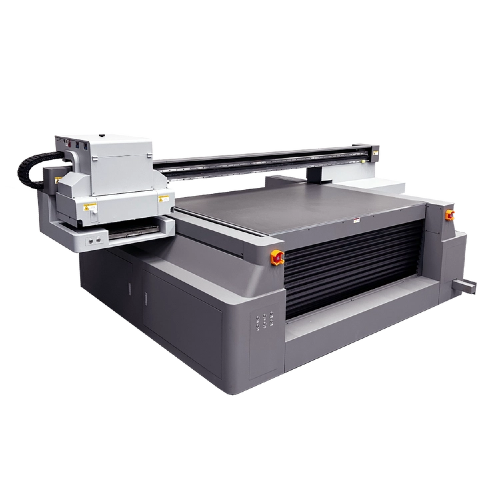
4. Step-by-Step Process: How a Flatbed UV Printer Works
Understanding the step-by-step workflow of a flatbed UV printer helps manufacturers and designers optimize print quality and efficiency. From substrate preparation to post-processing, each stage plays a critical role in achieving vibrant, durable, and precise results.
4.1 Preparing the Substrate
Proper substrate preparation is the foundation of successful flatbed UV printing. First, the surface must be thoroughly cleaned to remove dust, grease, or residues that could affect ink adhesion. Depending on the material, surface treatment such as primers or coatings may be required to enhance ink bonding, especially for non-porous or smooth surfaces like glass, metal, or certain plastics. Finally, accurate positioning of the object on the flatbed is essential. Securing the substrate prevents any movement during printing, ensuring consistent registration and alignment for multi-pass or multi-color designs.
4.2 Printing Process
Once the substrate is prepared, the printer begins the ink deposition stage. The flatbed UV printer’s print head moves precisely along the X and Y axes, applying UV-curable ink directly onto the surface. Multiple layers can be applied to achieve the desired color intensity or create dimensional effects. The technology also allows for complex designs, including intricate graphics, logos, and fine text, even on uneven or curved surfaces. This flexibility makes flatbed UV printers ideal for customized products and promotional items.
4.3 UV Curing Process
Immediately after the ink is deposited, integrated UV light sources cure it. This instant drying process prevents smudging or bleeding, ensuring a clean and precise finish. The cured ink is highly durable, scratch-resistant, and capable of withstanding regular handling. Additionally, layered printing can produce 3D textures or raised effects, adding depth and tactile appeal to the printed objects.
4.4 Finishing and Post-Processing
After printing, objects undergo inspection to verify color accuracy, design integrity, and overall quality. Some applications may benefit from optional coatings or varnishes to enhance durability or achieve a glossy finish. Finally, printed items are carefully removed from the flatbed for packaging or distribution, ensuring that the high-quality output of the flatbed UV printer is maintained throughout handling.
5. Advantages of Flatbed UV Printing
Advantage | Explanation |
High Precision | Capable of printing intricate designs and fine details |
Material Versatility | Prints on wood, glass, acrylic, metal, PVC, and more |
Multi-Layer / 3D Printing | Enables textured or raised designs |
Eco-Friendly | Low VOC emissions and minimal waste |
Fast Turnaround | On-demand printing with instant UV curing |
Durability | Scratch-resistant, weatherproof, and long-lasting prints |
Flatbed UV printers are particularly valuable for industries where aesthetics, durability, and customization are critical.
6. Applications of Flatbed UV Printers
6.1 Industrial Applications
Nameplates, electronic panels, and industrial labels.
Custom components with detailed markings or branding.
6.2 Promotional Products
Phone cases, trophies, awards, and gifts.
Supports small-batch customization and branding.
6.3 Home Décor
Printed tiles, glass panels, and decorative acrylic boards.
Enables creative and personalized interior designs.
6.4 Packaging Solutions
Luxury packaging and personalized boxes.
Adds high-quality graphics and logos directly to surfaces.
7. Factors to Consider When Using or Choosing a Flatbed UV Printer
7.1 Substrate Compatibility
Determine which materials will be printed.
Assess thickness and surface finish requirements.
7.2 Print Resolution and Image Quality
High DPI ensures sharp and detailed designs.
Layering capabilities support 3D effects.
7.3 Print Area and Object Size
Choose a printer that accommodates the largest objects in your production.
Consider adjustable beds for flexibility.
7.4 Production Speed and Workflow Efficiency
Evaluate throughput for small vs. large batches.
Multi-head systems or automation increase efficiency.
7.5 Maintenance and Technical Support
Regular cleaning of print heads is necessary.
Ensure availability of spare parts and software updates.
Manufacturer support is critical for minimizing downtime.
8. Conclusion
Flatbed UV printers integrate advanced digital technology, UV-curable inks, and precise mechanical systems to produce high-quality, durable, and versatile prints on a wide range of materials. Understanding how these printers work—from ink deposition and UV curing to software management—allows businesses to improve efficiency, reduce waste, and achieve professional-grade results. For companies seeking reliable and high-performance flatbed UV printing solutions, Dongguan Shenghuang Science And Industry Co., Ltd. offers a comprehensive selection of machines tailored to different production needs, material types, and design requirements. Their experienced team can provide professional guidance to help you choose the right printer for your specific applications. Explore their products or contact them directly to enhance your printing capabilities and take your production quality to the next level.
9. FAQs about Flatbed UV Printers
Q1: What is a flatbed UV printer?
A1: A flatbed UV printer is a digital printer that prints directly on rigid or flat materials using UV-curable inks, cured instantly by UV light.
Q2: How does UV ink curing work?
A2: UV light instantly solidifies the ink as it is deposited, creating vibrant, durable, and scratch-resistant prints.
Q3: What materials can a flatbed UV printer print on?
A3: Common substrates include wood, glass, metal, acrylic, PVC, and coated surfaces.
Q4: Can it print on irregular or thick objects?
A4: Yes. Flatbed UV printers can accommodate various thicknesses and some irregular shapes depending on machine design.
Q5: How is a flatbed UV printer different from a roll-to-roll UV printer?
A5: Flatbed UV printers print on stationary, rigid surfaces, while roll-to-roll printers handle flexible media such as vinyl or paper.
Q6: Are flatbed UV prints durable?
A6: Yes. Cured UV inks are resistant to scratches, fading, and environmental wear.
Q7: Can flatbed UV printers produce multi-color or 3D effects?
A7: Yes. Multiple ink layers and passes allow for multi-color printing and raised textures.
Q8: What should be considered when purchasing a flatbed UV printer?
A8: Factors include substrate compatibility, print resolution, bed size, speed, production volume, maintenance, and technical support.


